

Akio Morita, A Japanese businessman was in a restaurant in Dusseldorf (Germany) in 1953 when he ordered a dish of ice cream. Stuck into a scoop was a miniature decorative paper parasol. "This is from your country," the smiling waiter informed Morita.
The waiter intended to make Morita feel welcome in a foreign land, but instead he made Morita think, the way Japan was perceived. Later Morita wrote, "What a long way we had to go."
Japan was very behind in technological innovation. Morita had served as a naval officer in the World War II. Morita believed that the technology gap between Japan and the United States was not great. That illusion, however, was shattered when America dropped atomic bombs on Japan.
Morita realized that the Japanese were way behind and he had an important role to play in the post war renewal. He founded a start-up venture in 1946 with a partner, Masaru Ibuka - Tokyo Telecommunications Engineering Corporation.
Morita was surprised and impressed by Netherlands, a small agricultural nation like Japan which had produced a world class technology firm – Phillips.
During the course of time, the enterprise Morita and Ibuka formed became the famous, “Sony Corporation”.
Morita's greatest contribution was his success in improving the perception of Japan from a cheap imitator to a nation producing top quality products. Sony's labs produced technological innovations and lifestyle-altering gadgets - the Walkman portable cassette player, that became integral to the daily lives of consumers around the world.
One more major contribution from Morita was TL transistors – a breakthrough technology that would replace the vacuum tubes, and develop small high quality radios. Western Electric held the patent to the technology thought it could be used in little more than hearing aids. To get the rights from Western Electric, Morita required the approval of the Japanese Govt. which he didn’t have.
Mascarich, Western Electric's vice president of licensing gave Morita two technical manuals not available to the public before Sony had paid him a dime. They became the basic textbooks with which Sony's engineering team educated themselves about the transistor. Morita and Ibuka needed to pay Western Electric $25,000 as an advance on royalties to get the rights to the transistor technology, but MITI controlled the allocation of Japan's hard currency. Sony could not complete its agreement with Western Electric until MITI gave its consent.
After six months of haggling and waiting, Sony received approval from MITI. MITPs decision proved a turning point in global economic history. It ensured the future of Sony and was one of the earliest and most important steps taken in the creation of Japan's influential electronics and semiconductor industries. The japanese economic system later generated fear and hostility about Japan's rise to global prominence.
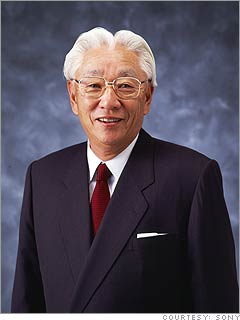
We should all join to try to make more Japans in other parts of the world. — Akio Morita
Akio Morita (26 January 1921 – 3 October 1999) was a Japanese businessman and co-founder of Sony along with Masaru Ibuka. As a businessman, Morita displayed an innate talent for understanding consumer behavior and identifying future technological and social trends. A lifetime lover of toys, he collected music boxes and player pianos, and never resisted a visit to New York City's famous toy store FAO Schwarz.7. "Sony's technological achievement in product design, production and marketing helped change the image of MADE IN JAPAN from a notion of cheap imitator to one associated with superior quality," wrote management gui Kenichi Ohmae."
Reference: "The Miracle" by Michael Schuman