
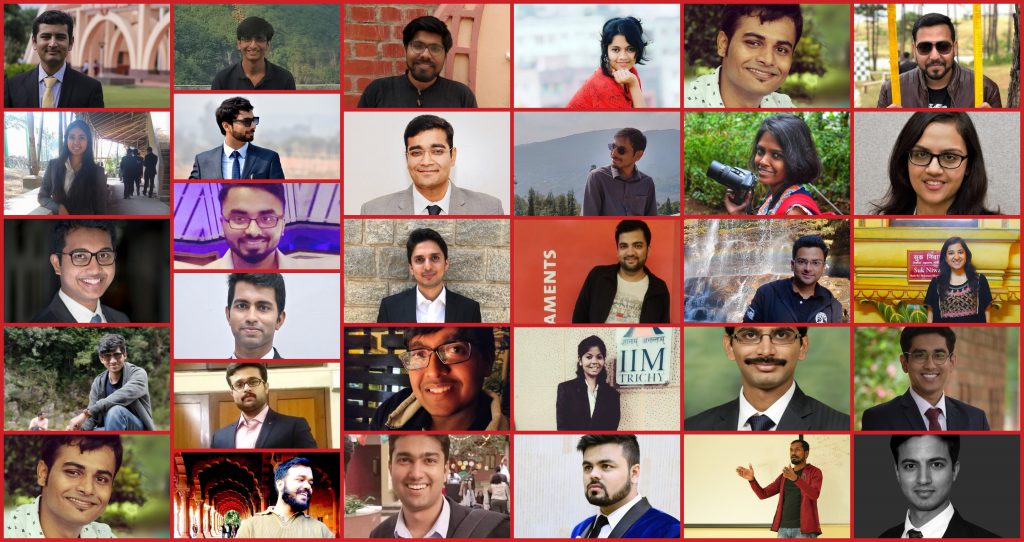
Meet India's Most Employable Management Graduates From The Class Of 2019
The results are out!
Team InsideIIM
The results are out!
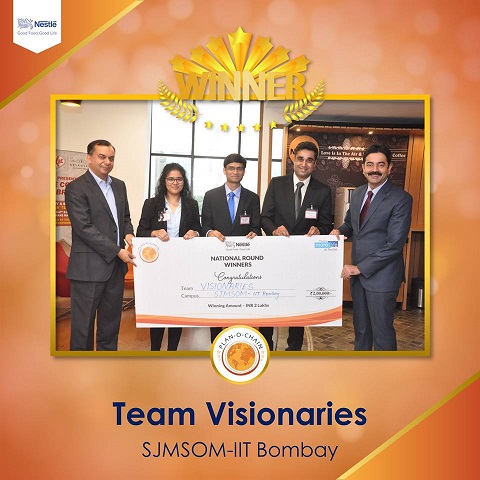
As part of the series on achievers from SJMSOM, IIT Bombay, we bring you the second instalment on winners of corporate competitions. Team Visionaries consisting of Daksh Gupta, Venkata Hareesh Kodi and Swetha Thomson won the prestigious Nestle Plan-o-Chain 2018.
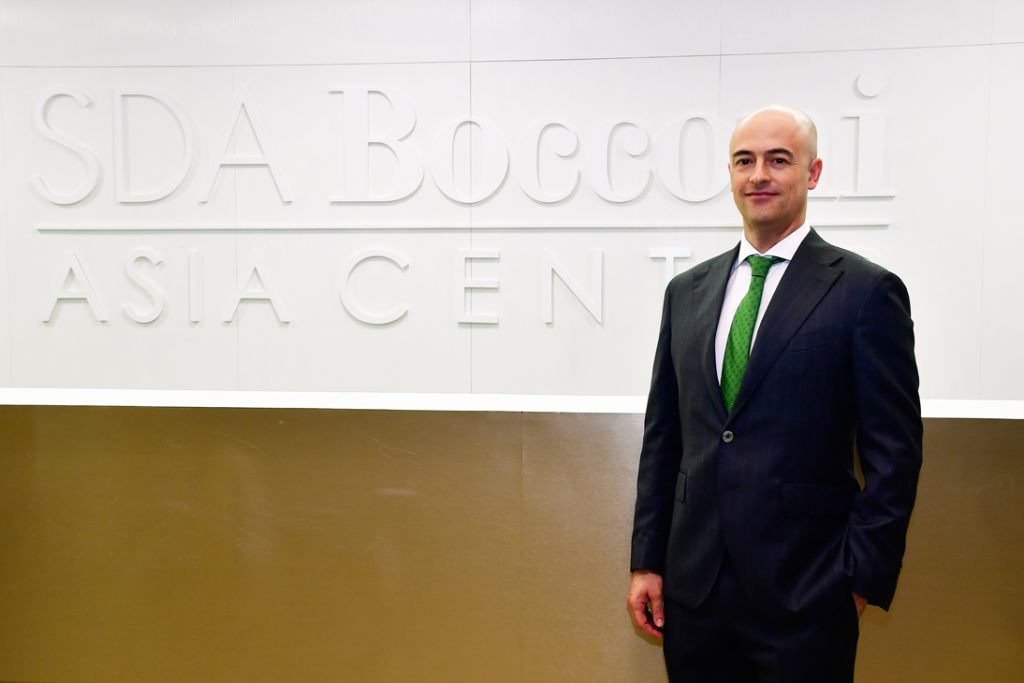
Case studies are an MBA staple. In all of my years as a strategy professor at SDA Bocconi and now the dean at SDA Bocconi Asia Center, I have always stressed how important it is to learn how to solve case studies. As a b-school student, you will be discussing case studies almost every day. Simply because you learn a lot from real life examples where you can put yourself in. A case study allows you to understand businesses and their challenges at a more practical and realistic level, as well as to apply theoretical frameworks is a useful manner. You'll learn how businesses can plan everything strategically, from their smallest investment to their biggest move, and you'll also understand the psyche with which these decisions are made. Whether you’re preparing for your b-school interview or an interview for your dream job, it is critical for you to know how to break down a very complex business problem and how to argue for and communicate the potential solutions. When you go to an interview and are asked to solve a problem, you’re mostly evaluated on your ability to demonstrate that you can identify and map the core elements of that situation parts that need to be investigated, that you are able to ask the right questions on each one of those elements and that you can then generate and analyse a number of alternative solutions and pick one of them. So, how do we break down a complex business problem? To help you understand how to solve a strategy case study let’s take the example of an airline company that is facing a particular investment decision. Assume that this airline company is already present in a certain country with a wide network of flights connecting numerous cities. Its prices are very competitive and its customers are particularly satisfied with its punctuality and general service. Now imagine that this airline has now a chance to buy some new slots in an airport where they are not present at the moment. It seems like a great decision to grow the business, but is it? How do we break down that case if we were in charge of making that decision? There are two fundamental pieces of analysis to perform here. First, you need to assess the investment opportunity itself, separate from whatever else the company is doing. For this, you need to calculate the return on investment of these new slots. You should look at the market and how many new customers you can get with those new flights, and you also should look at the cost of buying and running those slots. Now you would be able to calculate the return on investment measure that you can learn in any basic finance course. Let’s assume that the return on investment is good in this case. For the second part of the analysis, you need to assess the impact of that investment in whatever else the company is doing, that is, on the overall strategy of the company. This is a less straightforward and more difficult part. For that, you need to understand the business model of the company, that is, what are the two or three drivers that are absolutely core to that business model? If you look at the airline business you realize that one of its key drivers is the turnaround time. Turnaround time is the time that goes from the moment a plane lands in an airport, unloads the people and the baggage, loads the next group of people and their luggage in the flight, and then takes off again. It is important because during that time the company is not making money. So if it is very long, the company is losing money. Now, imagine that the company has the best turnaround time in the industry, about half of the industry average. Now you calculate the impact of that difference of less turnaround time on the company’s profit and loss account and you realize that two-thirds of the profit of that company makes comes from of the more efficient turnaround. So at this point what are the smart questions to ask about this case? First, if you buy those slots, what is the impact on the turnaround time of the rest of the airline’s network? Is that an airport that causes a lot of delays or not? Are there regular flight cancellations and constant delays? If so, you have a problem because if you start operating from that airport, your plane is going to take off late, it is going to arrive in another city late, which is going to increase the turnaround time in that city and so on and so forth; and all of a sudden you are running a business with a much higher turnaround time and you've lost a huge chunk of your profit as a consequence. So that would be one fundamental way to break down the case. First, separate the financial stand-alone assessment from the strategic impact assessment. Second, when you get into the strategic part you need to identify the two or three key drivers of the business model of the company because those are the ones that you have to protect, at all costs. If the new investment impacts those drivers negatively, you might not make it even if the stand-alone return is very positive. So why is it so important to learn to break down cases? Well, because management is all about solving complex problems and finding the best solution among a set of alternatives. When you go into an interview, the person in front of you wants to know if you’re capable of understanding the scope of a problem and asking the right questions through a structured approach. It is a discipline that we intensively teach in all our courses and programs at SDA Bocconi Asia Center because we realize how critical it is for students and managers, whether they are facing a job interview or an actual real-life situation at work. Prof David is the Dean of SDA Bocconi Asia Center. He teaches the course “Strategic and Entrepreneurial Management” at the Asia Center and is an Assistant Professor in the Department of Management and Technology at Bocconi University, Milan, Italy. He has completed his degree in Industrial Engineering from Universitat Politècnica de Catalunya and also earned his Master in Business Administration from IESE Business School in Barcelona. He also went on to complete his Ph.D. in Management from the University of California Los Angeles (UCLA).
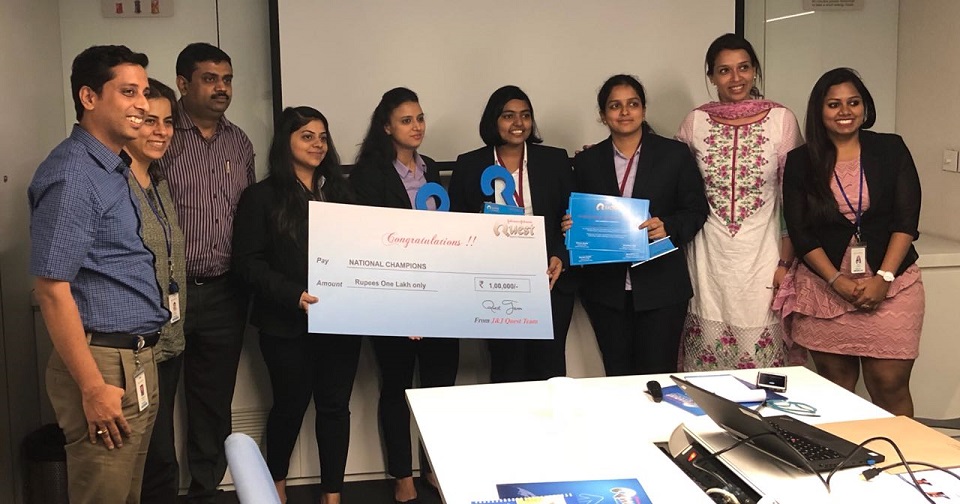
Corporate competitions play an important role in the b-school experience of every MBA student. These competitions witness fierce competition among the students, and you need fortitude, perseverance and skills to win in one. As part of our series on achievers from SJMSOM, IIT Bombay we look at teams from SJMSOM that have managed to achieve success in these competitions.

Everyone can rise above their circumstances and achieve success if they are dedicated to and passionate about what they do. - Nelson Mandela

Mr. Satya Shankar Mahapatra has a proven track record of 17+ years in the areas of Investment Banking and Financial Services. He has worked in various capacities such as Delivery and Project Manager for the Credit and Market Risk programs, Senior Analyst for Algo Trading Platforms, Quant Analysis, Strategic Risk Program, Business Consulting in Operations and Technology. He has worked at global behemoths like Polaris, Infosys Limited, Credit Suisse, J.P. Morgan and is currently working at Barclays Investment bank in the capacity of Senior Vice President. He has completed his masters from prestigious Xavier Institute of Management, Bhubaneswar (XIMB) and graduation in B.Tech from NIT Calicut.

Winston Churchill rightly said that Success is not final, failure is not fatal, it is the courage to continue that counts and exemplifying this is Mr. Krishna K V.

Quoted by Anton Chekov “Knowledge is of no value unless you put it into perspective”, stands true in what I fathomed from my interaction with Mr. Rabindra Jena, COO Global Markets, Credit Suisse India. As lost as I might’ve been while seeking out for leaders, I chose to settle with someone I’d relate to the most. Talking to your alum instils a sense of confidence and positivity, which very much was the case with RJ (so he prefers to be called). His career graph from pursuing Mechanical Engineering, then moving on with an MBA in Finance, Strategy & Operations and ultimately now working for an international firm, is something that intrigued me about him. I came across him from my college alumni members on LinkedIn. Despite his tight schedules and deliverables, his instant responses to my messages showcased his unflinching attitude and thus helped me develop a congenial rapport with him.