

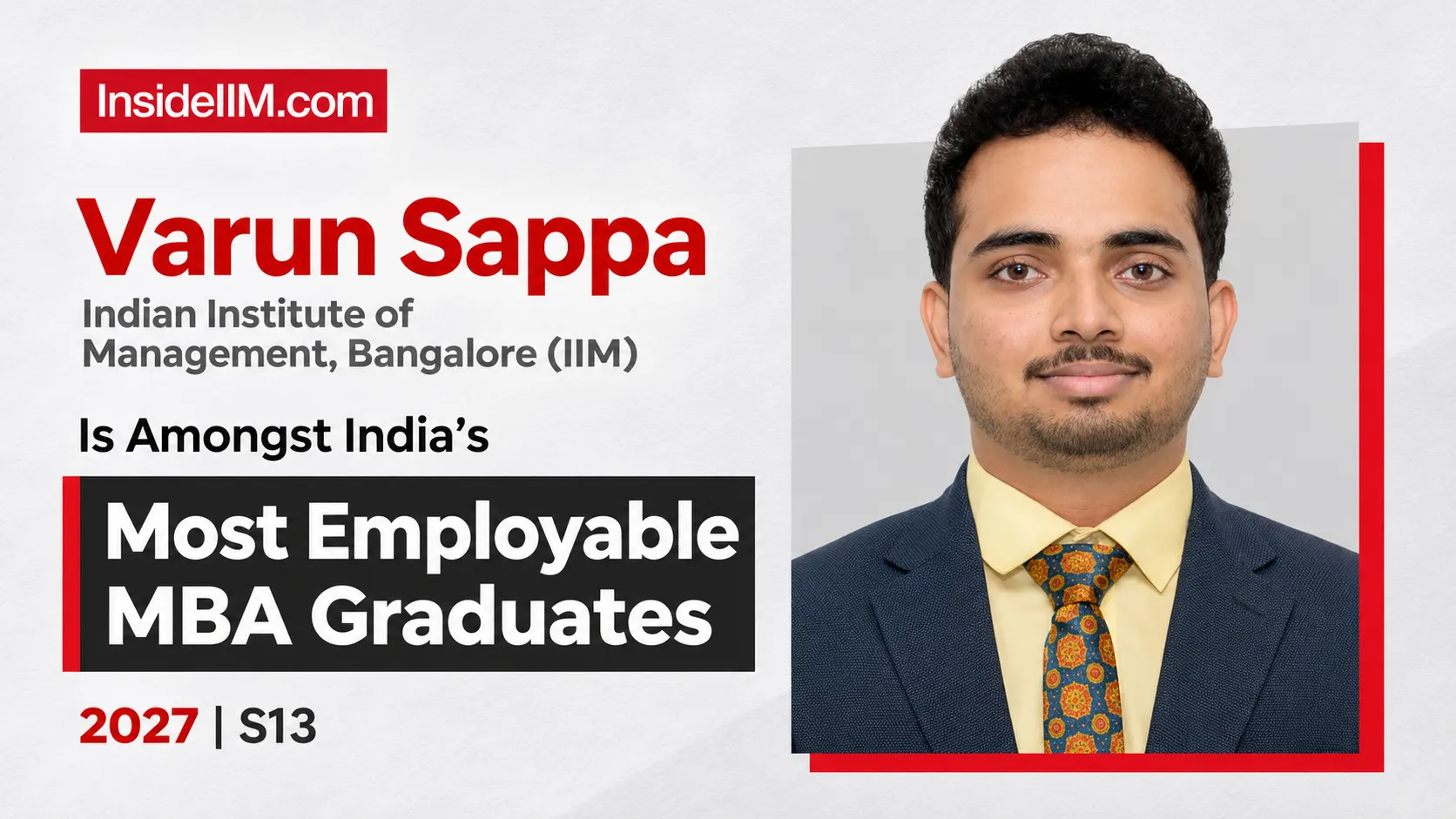
Varun Sappa’s Unusual Career Has Built a Particular Kind of Usefulness
“What it has built is a particular kind of usefulness.”
For Varun Sappa, the line is less a polished slogan than a description of how the career has taken shape. The formal journey began at Indian Institute of Technology, Kanpur (IIT) UG, and now continues at Indian Institute of Management, Bangalore. The route between those points has been defined by work that repeatedly moved from analysis to execution.
InsideIIM has recognised Varun Sappa among India’s Top 50 Most Employable MBA Graduates from the Class of 2027. The recognition matters here because it sits alongside a more revealing question: what has Varun Sappa learnt to do when the answer is not already available?
The Work Behind the Direction
Aerospace, cognitive science, management and cross-functional roles form a deliberately broad but coherent problem-solving path. That progression gives the profile a through-line without pretending every step was planned from the beginning.
multiple cross-domain roles with quantified project results, including software/product/strategy work. These are not simply scale indicators; they show where responsibility moved from completing an assignment to improving an outcome.
Applied work across technical and business domains demonstrates problem solving; no national competition podium cited. Competition results are useful only in context: the stronger signal is the willingness to test an idea against constraints, feedback and other teams.
What the Résumé Does Not Show
In the candidate response, Varun Sappa wrote, “The one I value most is the pre-placement offer from EY, because investment banking was the furthest thing from where I started, and the people who made that call had watched me work for two months.” The observation gives the chronology a human centre: progress has come through examining unfamiliar work closely enough to become useful in it.
Another line is equally revealing: “I would rather find the mistake myself than have someone senior find it.” It describes a working style built around learning before certainty and taking responsibility before a title makes that responsibility explicit.
Leadership in teams/work is evidenced, though formal positions are less prominent. The value of that experience lies not in the size alone, but in the coordination required to make other people’s work easier or more effective.
Self-built tools and exchange/academic distinctions demonstrate initiative beyond standard coursework. It adds dimension to a profile that could otherwise be read only through academics and employment.
Seen as a whole, the career direction is becoming clearer. Resume shows multiple cross-domain roles with quantified project results, including software/product/strategy work. The point is not that every move was predictable; it is that each one added another way to understand the decisions organisations and customers make.
That distinction matters for Varun Sappa. Employability here is not a claim that one internship, qualification or competition result settles the question. It is the accumulated evidence of how Varun Sappa approaches new information, works with other people and turns an ambiguous brief into a result that can be examined. Those habits are more portable than any single job title.
The strongest clue is still the opening thought. Varun Sappa has not built employability by claiming to know every answer. The more durable pattern is a willingness to enter the problem, understand what the situation requires and remain accountable for what happens next.