

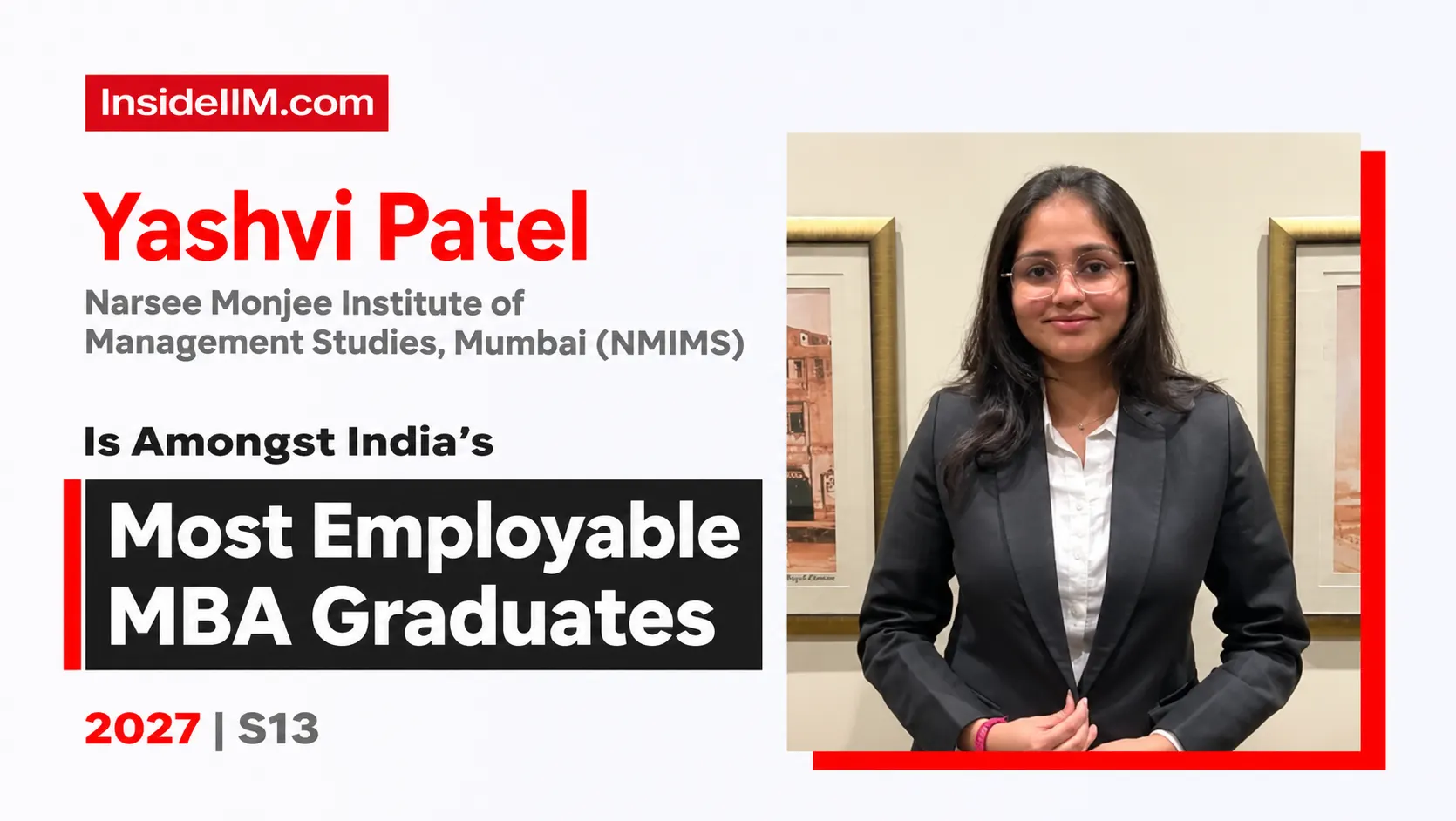
Yashvi Patel Learns by Getting Close Enough to See the Real Problem
“I learn best by getting close to the problem, understanding different stakeholder perspectives, and then using data and insights to identify practical solutions.”
For Yashvi Patel, the line is less a polished slogan than a description of how the career has taken shape. The formal journey began at R. A. Podar College of Commerce & Economics, and now continues at Narsee Monjee Institute of Management Studies, Mumbai. The route between those points has been defined by work that repeatedly moved from analysis to execution.
InsideIIM has recognised Yashvi Patel among India’s Top 50 Most Employable MBA Graduates from the Class of 2027. The recognition matters here because it sits alongside a more revealing question: what has Yashvi Patel learnt to do when the answer is not already available?
The Work Behind the Direction
Bimbo internship reports outlet-level sales/distribution gains; civic venture work adds operating and fundraising outcomes. These are not simply scale indicators; they show where responsibility moved from completing an assignment to improving an outcome.
What the Résumé Does Not Show
In the candidate response, Yashvi Patel wrote, “I believe this combination of curiosity, adaptability, ownership, and execution orientation is what I would bring to a management trainee role, along with a strong willingness to learn and take on new challenges.” The observation gives the chronology a human centre: progress has come through examining unfamiliar work closely enough to become useful in it.
Another line is equally revealing: “I tend to keep thinking about how it can be improved until I am satisfied with the outcome.” It describes a working style built around learning before certainty and taking responsibility before a title makes that responsibility explicit.
Bookwallah initiative and Tata Imagination recognition show meaningful extracurricular initiative. It adds dimension to a profile that could otherwise be read only through academics and employment.
Seen as a whole, the career direction is becoming clearer. Marketing internship, consumer GTM and civic growth work form a coherent commercial strategy direction. The point is not that every move was predictable; it is that each one added another way to understand the decisions organisations and customers make.
That distinction matters for Yashvi Patel. Employability here is not a claim that one internship, qualification or competition result settles the question. It is the accumulated evidence of how Yashvi Patel approaches new information, works with other people and turns an ambiguous brief into a result that can be examined. Those habits are more portable than any single job title.
The strongest clue is still the opening thought. Yashvi Patel has not built employability by claiming to know every answer. The more durable pattern is a willingness to enter the problem, understand what the situation requires and remain accountable for what happens next.