AI in campus hiring: Hindustan Unilever's Foundation School, seven editions in
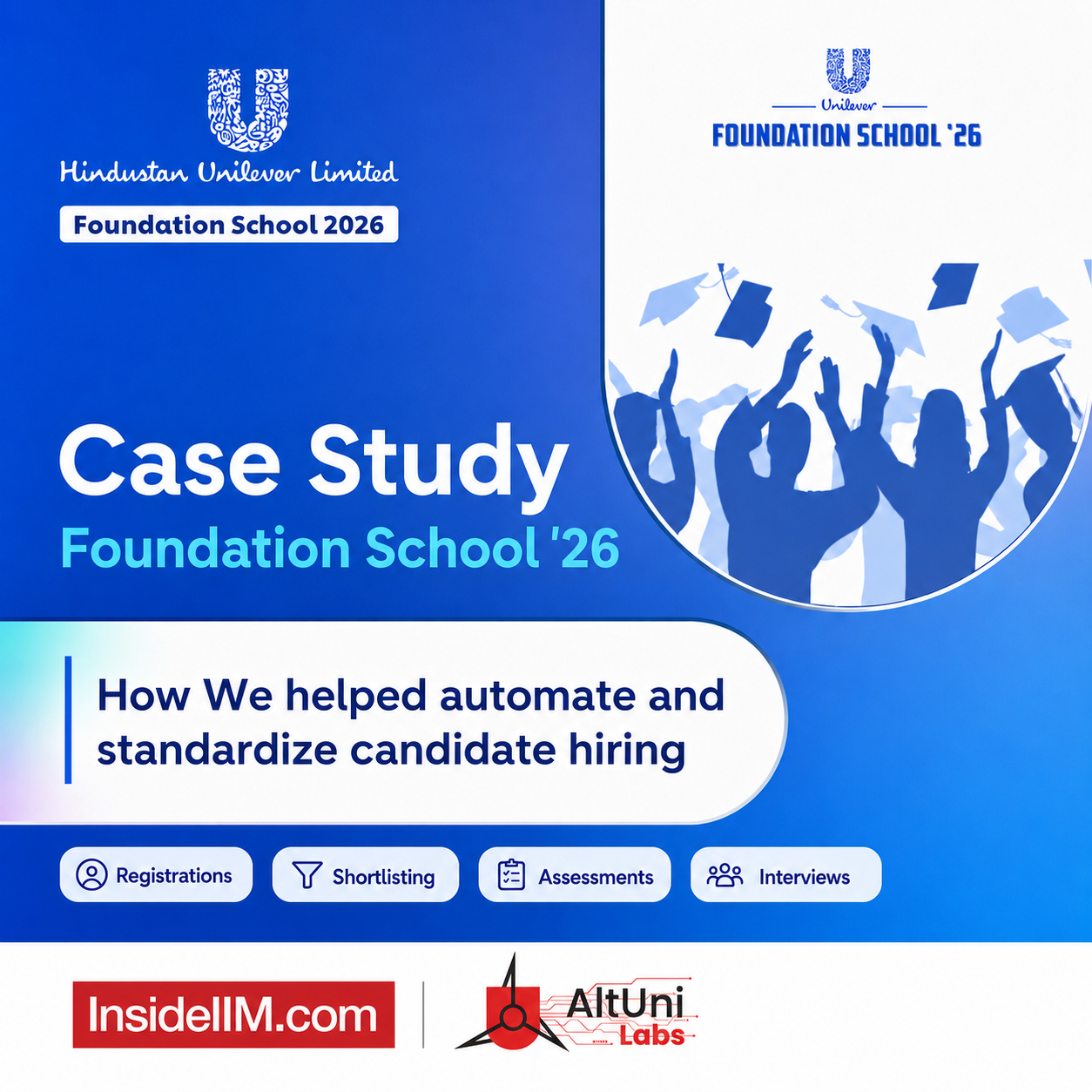
Hindustan Unilever runs Foundation School as its flagship pre-campus talent property, built and delivered with InsideIIM and AltUni Labs for seven consecutive years. In the latest edition the selection layer moved onto the AltUni Labs AI stack, which uses PotentialAI for resume screening, SignalAI for a narrative-led behavioural simulation, and KonverseAI for function-specific AI interviews, automating shortlisting, assessment and evaluation against a pre-determined scientific framework. Applications tripled year on year, and the talent team absorbed all of it without additional workload.
Problem: Manual screening caps how far a pre-campus property can scale
Foundation School was never short of interest. Seven editions in, the constraint was throughput.
Every additional application became additional screening work, and that work landed on the same talent acquisition team inside the narrowest window of the campus calendar. Three pressures compounded:
- Screening volume outpacing screening capacity. More applicants meant more resumes reviewed manually, by the same number of people, in the same number of weeks.
- Evaluation drift across the funnel. When shortlisting is distributed across reviewers and spread over weeks, a candidate assessed in week one is not held to quite the same standard as a candidate assessed in week four.
- Depth versus scale. Foundation School's reputation rests on the depth of its selection process. Any efficiency gain that flattened the assessment into a generic aptitude test would have cost the property the thing that made it work.
Solution: AI layered across screening, simulation and interviews
InsideIIM and AltUni Labs built the selection layer on OneAI, with Unilever's own competency framework as the single scoring standard at every stage. The AI was layered onto the existing property rather than replacing it, so the branding, the community outreach and the human final round stayed intact.
The AI-led selection flow
| Stage | What ran | Module |
|---|---|---|
| Registrations | Campus outreach and applications across the InsideIIM community | InsideIIM.com, InsideKampus |
| AI shortlist | Real-time resume screening surfacing role-aligned talent from the full pool | PotentialAI |
| Gamified assessment | Narrative-led behavioural simulation measuring grit, resilience and execution | SignalAI |
| AI interviews | Function-specific interviews scored on communication, reasoning and role fit | KonverseAI |
| Final round | Three-day physical immersion at Unilever HQ | Delivered end to end |
AI resume screening against a competency framework
PotentialAI evaluated every application in real time against Unilever's role competencies rather than matching keywords.
- Score and rank CVs and essays against defined role competencies
- Return competency-level assessments with evidence quoted from the candidate's own application
- Attach a plain-language recommendation to every profile
- Surface role-aligned talent from across the full pool, not just the top of the pile
- Apply an identical standard regardless of campus or application date
Narrative-led behavioural simulation
SignalAI delivered a custom simulation built specifically for Foundation School. Choices played out as a story: candidates faced pressure, ambiguity and shifting priorities, and the simulation recorded how they behaved rather than what they knew.
Every decision compounded into the next, which exposes consistency, resilience and judgement, something single-shot tests structurally cannot capture. Unilever defined the competency framework first; the simulation was then built to generate evidence against it, and the scoring was built on top of that evidence.
Function-specific AI interviews
KonverseAI ran AI-led screening interviews ahead of the final round, including for the engineering cohort.
- Function-specific question sets rather than one generic interview
- Every response scored on communication, reasoning and role fit
- Only qualified candidates passed forward to the human round
- The same competency framework carried from screening through to interview
The property around the AI
Four teams delivered Foundation School end to end.
- Branding and microsite. Logo, creatives and content built from scratch on a dedicated microsite hosted on InsideIIM.
- Customer success and outreach. A dedicated team driving registrations, coordinating students and the Unilever team, and holding execution together through the cycle.
- Tech and AI. The simulation, the screening competency framework and the AI interviewer, built to filter candidates exactly as the hiring team wanted.
- Social media outreach. Reels, shorts and creative carousels to build momentum around the property.
- Final round. A three-day physical immersion at Unilever HQ for the finalist pool.
Impact
- Applications tripled year on year, a 3X jump and an all-time high for the property, absorbed without adding to the talent team's workload
- Shortlisting, assessment and evaluation automated end to end against a pre-determined scientific framework
- Shortlisting compressed from weeks to days, inside the tightest window of the campus calendar
- The bar held. The funnel still narrowed to a sharp, high-conviction finalist pool, flown in for a three-day immersion at HQ
- Seventh consecutive edition delivered with InsideIIM and AltUni Labs
Before AI and after AI
| Area | Before AI | After AI |
|---|---|---|
| Applications received | Baseline | 3X |
| Resume screening | Manual review by the TA team | Real-time AI profile evaluation against role competencies |
| Shortlisting time | Weeks | Days |
| Evaluation standard | Varies by reviewer and by week | One scientific framework applied to every applicant |
| Assessment | Conventional test formats | Narrative-led behavioural simulation reading patterns over time |
| Interviews | Human panels from the first round | AI-led function-specific screening, humans at the final round |
| Explainability | Reviewer judgement, hard to reconstruct | Competency-level scores with evidence quoted from the application |
| Scale limit | Capped by team capacity | 3X the applications absorbed with no added workload |
Key takeaways for talent teams
Common challenges
- Screening volume growing faster than TA team capacity
- Inconsistent evaluation across campuses, reviewers and application dates
- Pressure to scale a property without diluting the assessment
- AI-scored shortlists that hiring managers cannot interrogate or defend
- Candidate relationships built too late, once the season is already crowded
Practical guidance
- Define the competency framework before designing any assessment, then build the assessment to generate evidence against it.
- Layer AI onto an established property rather than rebuilding it; the brand equity is the hard part.
- Use behavioural simulations that compound decisions over time, since single-shot tests cannot read consistency or resilience.
- Keep the final round human. AI belongs at screening, where the volume lives.
- Insist that every score carries its evidence, so any ranking can be opened and explained internally.
- Run pre-campus, not in-season. Familiarity built months ahead is what converts at Day Zero.
Ready to run AI in campus hiring?
We design and execute campus talent properties end to end, combining outreach, branding, AI-powered assessments and interviews on a single stack, delivered with speed, precision and measurable outcomes at scale.