

Economics is of the commonly tested areas for MBA interviews. Economics concepts are interesting and fairly easy to understand. In simple terms, economics is about making choices. It can be classified into two parts based on its scope: Microeconomics and Macroeconomics. In this article, we shall try and cover the various concepts related to Microeconomics.
Let us first try and understand why do we need to study economics.
Economics
Economic resources are limited and there are multiple uses of the same resources. Thus, there are always trade-offs to be made. Economics is the science of the optimum or best utilization of economic resources.
For the field of economics to exist, we need to first understand an economic good.
Economic good
An economic good is a physical object or service that has value to people and can be sold for a non negative price in the market.
Example of economic good: bread, oil, education
Example of non-economic good: air, pollution, peace, friendship
A market is a place where the exchange of an economic good occurs. A market is characterized by demand and supply.
Demand
Demand is the want or desire to possess an economic good, backed by the necessary financial capability to buy that good at a given price.
Supply
Supply is the total quantity of an economic good that is available for purchase at a given price in the market.
The demand and supply of an economic good leads to the variability in its price. Consider the case where the shortage in the supply of an economic good leads to a hike in the price of that commodity.
An economic good can again be classified into two types based on their usage. These are:
| Complementary good | Supplementary good |
| An economic good which is usually used along with another good.
Ex: Tea – milk, sugar Pen – ink, paper |
An economic good which is used in place of another good.
Ex: Tea – coffee, cold drinks Pen – pencil, crayon, brush |
Another important distinguishing is based on the usage of the product.
| Consumer | Customer |
| An individual who acquires an economic good for direct use or consumption and not for resale or use in the production of some other economic good.
Ex: A person buying a motorcycle for his personal use |
An individual who purchases an economic good on behalf of the consumer.
A customer may be different from consumer. Ex: Government purchasing oil for OPEC for consumption by the people |
An important concept is the Law of Demand and Supply and the law of Diminishing Marginal Utility which gives rise to it.
Law of Demand
The higher the price of an economic good, the lower the quantity demanded, ceterus paribus.
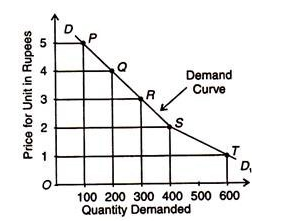
Demand curve of a normal economic good is downward sloping.
Diminishing Marginal Utility
The utility, and therefore the demand of every incremental unit of an economic good diminishes as we increase its consumption.
Consider that you are hungry and you have a pack of biscuits. The utility that you will derive from having the first piece would be maximum as it would lead to the highest satisfaction. The utility from the second biscuit would be slightly lower as your hunger has partly been satiated after having the first one. Since, the utility has decreased, you may not be willing to pay the same amount for the subsequent ones. This phenomenon is known as diminishing marginal utility.
Implications:
- The price will have to be reduced to sell every incremental unit
- If the price reduces, the demand increases
Other factors affecting demand
- Income
- Tastes and Preferences
- Price of complementary good
- Price of the substitute good
- Price expectations of the customer
- Number of customers (at a macro level)
Exceptions to the Law of Demand
· Giffen Good / Inferior Good: If the good is inferior or poor quality without any close substitute where increasing the price would lead to a rise in the demand of the good.
Consider the example of lamb and bread (giffen good). Here, lamb is costlier and bread is cheaper and inferior. If the price of bread increases, the consumer would not be left with adequate money to buy lamb.
Hence, he would cut down on his consumption of lamb and spend it on the inferior good i.e. bread to consume the same quantity based on his needs
· Veblen Good (snob effect, bandwagon effect): These goods are luxury goods and have a snob appeal. They are not common place and cannot be afforded by all. Hence, it their price increases, they are demanded more – as they indicate a status symbol.
Example of Veblen good: Diamond Antiques, Super Luxury Cars
Law of Supply
The higher the price of an economic good, the higher its quantity supplied, ceterus paribus.
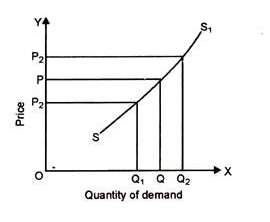
The supply curve of a normal economic good is upward sloping.
Other factors affecting supply
- Price and availability of resources
- Price of complementary goods
- Price of substitute goods
- Technological changes
- Price expectations of the seller
- Taxes and subsidies
- Number of sellers (at a macro level)
Price determination in a marketplace occurs at a point where the demand and the supply curve intersect with each other. This gives rise to equilibrium.
Equilibrium
The point where the demand and the supply curve intersect is known as the equilibrium. This works like the invisible hand of the market. It is a state where the supply and the demand curve balance each other, against which the price can be determined.
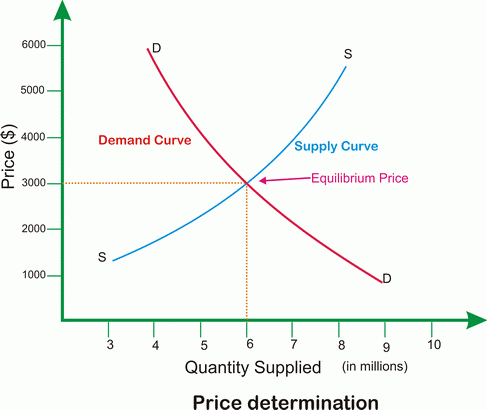
Changes in equilibrium happen when
- Change in quantity demanded
- Shift in demand
- Change in quantity supplied
- Shift in supply
These are the few important concepts related to Microeconomic. They are also useful as you go through your MBA program. Also, refer to this article for questions related to Economics.
All the Best!