

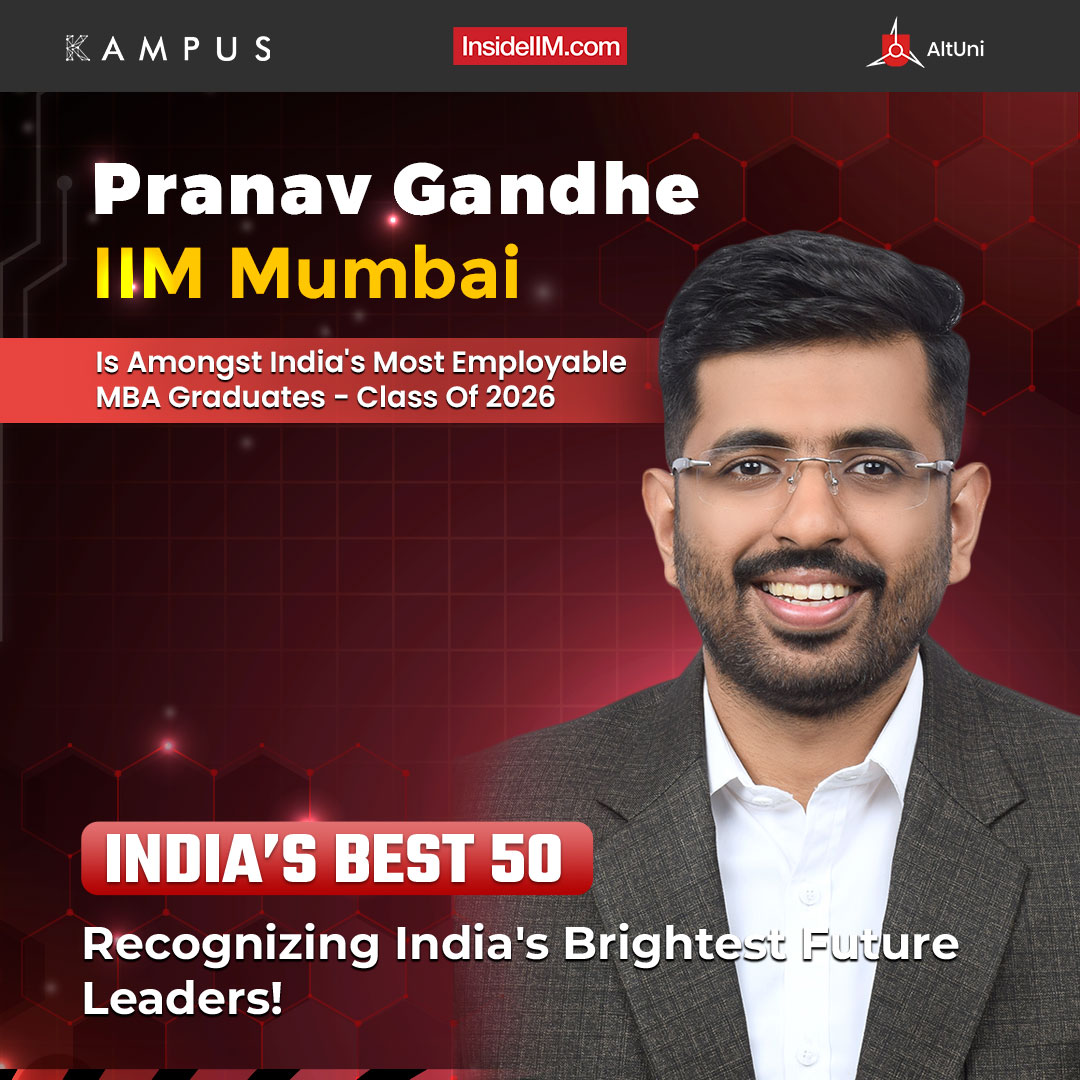
When you meet Pranav Gandhe, what stands out first isn’t just his calm confidence — it’s the balance he strikes between technical precision and human understanding. A first-year MBA candidate at IIM Mumbai, Pranav’s story is shaped by resilience, curiosity, and an instinct to connect technology with purpose. From optimizing critical financial systems at Citi to mentoring teams and adapting across cities, he’s built a career that values both performance and people. Scroll down to read how Pranav turned every move — geographical, academic, and professional — into a stepping stone toward growth.
Build a real AI app, earn a certification in 21 days & stand a chance to win ₹2,00,000 — Join the challenge now!
From Pune to IIM Mumbai: A Journey of Adaptability and Depth
Pranav’s journey began in Navi Mumbai, then shifted through Nashik and Pune, where he learned early on that change is constant — and that adapting to it is a strength, not a struggle. Each move brought a new school, new friends, and a new sense of belonging. It wasn’t easy at first. “In Nashik, I felt out of place for months,” he recalls. “But I realized that sometimes, starting over gives you a chance to understand yourself better.”
That quiet resilience followed him into his undergraduate years at the College of Engineering, Pune (COEP), where he graduated among the top ten students in Electronics and Telecommunication. As Head of Corporate Outreach for MindSpark, COEP’s annual techfest, he learned how collaboration and communication could turn complex projects into successful experiences.
His professional chapter began at Citi, where he joined as a Technology Analyst and quickly made his mark. In just two months, Pranav resolved a system issue that was blocking millions of trade messages — an error that risked data loss for global clients. By identifying the root cause and optimizing the backend logic, he restored uninterrupted trade flow and strengthened the system’s long-term reliability. His initiative earned him the Employee of the Month award — the first of two — and a fast-track promotion soon after.
At Citi, he contributed to projects in brokerage reconciliation, collateral management, and FX risk hedging, working at the intersection of technology and finance. What set him apart wasn’t just his technical skill, but his ability to understand how backend systems shape business outcomes. “It wasn’t just about writing efficient code,” he says. “It was about understanding how every fix or feature impacted a client, a trader, or a process downstream.”
The Core of Who He Is: Curious, Collaborative, and Calm
Pranav’s success rests on three quiet but powerful strengths.
The first is adaptability. Having lived in different cities and worked across multiple teams at Citi, he learned to blend into new environments and thrive under uncertainty. For him, change isn’t something to endure — it’s something to grow through.
The second is collaboration. Whether leading corporate partnerships at MindSpark or coordinating across global teams in Citi, Pranav believes that open communication can solve almost anything. He recalls nights when projects were on edge and deadlines closing in, but a calm discussion with colleagues across time zones made everything click again.
The third is curiosity. It’s the thread that connects his engineering background with his business education. Pranav doesn’t stop at “what” or “how”; he always asks “why.” It’s what led him to explore new technologies, new ideas, and, eventually, the decision to pursue an MBA — to strengthen his understanding of the business contexts that technology operates within.
The Employable Edge: Bridging Tech with Business
In an AI-driven business world, where data moves faster than decisions, Pranav’s greatest strength lies in bridging technology with business context. During his time at Citi, he built backend systems that not only ran smoothly but also aligned with broader strategic goals. “You can automate anything,” he says, “but what matters is why you’re automating it — what problem you’re solving, and for whom.”
Now, at IIM Mumbai, he’s sharpening that instinct through coursework and case competitions, learning to pair data-driven insights with business judgment. It’s this rare blend of technical fluency and strategic thinking that makes him stand out in today’s AI-augmented world — a professional who not only builds tools but understands how to use them to create impact.
A Moment That Defined His Character
Every professional has a moment that reveals what they truly value. For Pranav, it came during a critical project at Citi. His team was migrating millions of records to a new system when a teammate had to take sudden leave due to a family emergency. The workload doubled overnight, and deadlines loomed large.
Without hesitation, Pranav volunteered to take on his colleague’s share. He learned new modules over a weekend, coordinated with external teams, and worked late nights to ensure nothing slipped. The project was completed on time, and leadership praised the team’s commitment. But what mattered most to Pranav was the human side of the story — that his teammate could take care of family without guilt or worry. “That experience taught me that success isn’t about doing your part; it’s about making sure the whole team crosses the finish line,” he reflects.
The Grounded Learner
Beneath the achievements and awards, Pranav remains deeply grounded. His early experiences — moving cities, adapting to new environments, and starting from scratch more than once — have made him someone who doesn’t take growth for granted.
He celebrates small wins: learning a new tool, running a faster mile, solving a coding challenge that seemed impossible the day before. These moments, he says, keep him humble and hungry.
At IIM Mumbai, he continues to build on that foundation — combining analytical clarity with empathy, precision with perspective. For organizations looking for someone who can connect people, process, and purpose, Pranav Gandhe represents the kind of professional who not only delivers results but understands the meaning behind them.