

Hi all, my name is Sparsh Maharshi, and here I am trying to share my journey from a tiresome core job to IIM Calcutta.
I come from a rural village in Rajasthan, so competitive exams for me mostly meant government job exams. I only heard about IIT-IIMs during my 11th standard when I saw some of my friends starting “distance schooling” for JEE preparation and I don’t know why, but from that moment, I started dreaming of a different life—engineering from IIT, 2–3 years of work (because I heard it’s mandatory to have work experience before an MBA), and then MBA from an IIM. At this time, I wasn’t even aware of how many IIMs existed—forget knowing their names.
Note From Editor -> Free CAT Mocks 2025: Daily Sectionals!
But time passed, and I joined NIT instead of IIT, so I already got off-track from the “perfect dream.” My grades in UG college were sub-par, and I didn’t even care, because my final destination was MBA from an IIM, right? What if my first step on the ladder wasn’t perfect—I still had options to do better. After graduation, I joined JSW Steel, a core mechanical job—so yeah, life was on track.
Fast forward to one year into the job, and I thought, “Okay, this is the best time to prepare for B-schools.” I always believed that hands-on experience is the best way to judge the difficulty level of an exam. So I filled out the CAT 2023 form and took it without any preparation whatsoever. I scored 88.83 percentile in CAT 2023. This wasn’t enough to get into any IIM, but it was enough to give me confidence for taking CAT 2024 with full force.
So that is how my real journey to IIM Calcutta started—with a “failed” attempt in CAT 2023.
Like any other serious aspirant out there, I looked at probable colleges, because in MBA aspirants’ terms, I am a GEM with a 9/9/6 profile—so it was clear that anything below 99.5 percentile in CAT was of no use to me. One big mistake I avoided in the starting phase was looking for the exact cutoff percentile for each college. I only knew the goal was 99.5 percentile in CAT 2024, and after that, everything would be in God’s hands.
But there was one big problem for me. Like most of my peers, I didn’t have a 9-to-5 job with two days of weekend. What I had was a field job on terrains of white lime dust, where you couldn’t stand without a mask for 10 minutes. On top of that, I had shift duty—which changed my schedule from waking up early for a 6 AM shift to sleeping during the day to stay awake all night for a 10 PM–6 AM shift. I didn’t have Sat-Sun weekends—what I had was a week-off that could come on any weekday, depending on work requirements.

All these odd working hours and non-fixed weekly offs meant that I couldn’t rely on a fixed study schedule strategy. What I needed was a flexible strategy so I could adapt and maximize study time. Keeping this flexibility and high percentile target in mind, I looked for online courses, as offline classes were out of scope. I found the TIME online course most suited for me—it felt more secure because of its legacy brand, and they had live classes at 6:30 PM, which meant I had a 67% chance of attending. For missed classes due to work, I relied on the recordings provided.
So now, the platform, target, and medium were all set. With that, I started my full-paced preparation in March 2024. One good thing about TIME was the option to take AIMCATs (their mocks) even before completing the course. So, I took the first mock and got the gist: I could achieve the targeted percentile, but I needed to fine-tune sectional strategies.
As I didn’t have fixed weekends, I decided to take the active AIMCAT on whatever weekly off I got. Also, for solving material, I needed a flexible approach, since my shift duty changed from A-B-C every two days. Some days I was waking up at the time I should have been sleeping on another day. It was absolute chaos—but there was one good thing: weekly shift schedule changes meant I could set weekly targets. So, I started doing that.
My Study Strategy
I set weekly targets for how many exercises I would solve, how many RCs I would read, and on which weekday I would take the mock. These weekly targets meant I wasn’t time-bound—I had the liberty. If I felt sleepy reading RCs, I could switch to QA questions instead of wasting time. I’ve always believed—from my JEE days—that after a certain time, the mind needs a break, and no matter how urgent something is, it’s best to take a break and nap.
I had plenty of TIME material, and my syllabus was almost covered by June-end. So, I decided to go full throttle and complete the material ASAP. On some online advice, I collected material from other coaching sources too, but I could hardly practice them.
After watching some peers, I realized it’s best to take two different mocks to get a diverse question set. So, I chose Arun Sharma mocks, which were ₹199 for 10 mocks at the time. They did come in handy. In AIMCATs, I was constantly scoring 80–90 marks, but in Arun Sharma mocks, I started with scores in the 50s. The DILR sets went completely over my head, and VARC seemed like the next level. But gradually, I picked up the pace and started scoring well there too.
My Mock Strategy
Over nine months of my CAT journey, I took 50+ mocks, including AIMCATs, Self-AIMCATs, Arun Sharma mocks, and PYQs. With each of them, I tested different exam strategies and fine-tuned the best one for myself.
For VARC, I realized my accuracy wasn’t directly affected by the number of attempts—I could maintain similar accuracy at any attempt level. So, I decided to go for all 24 questions. My final strategy was: 7x4+12—7 minutes for each RC and 12 minutes for the 8 VA questions.
For DILR, I practiced enough to attempt 2 sets easily by PYQ standards and could go for a third. So, I started glancing through all 5 sets, ranked them by difficulty and time required, and started with the easiest.
For QA, from the very first mock, I knew I could attempt all 22 questions—I just needed to skip questions not going anywhere after 90 seconds. That’s what I did: target solving each QA question in under 90 seconds—the faster, the better. If after 90 seconds I sensed the answer coming, I’d solve it; otherwise, I moved on.
That’s how I made a strategy for each section and waited for D-Day.
The CAT Day and Aftermath
I had Slot 1 in CAT, so I reached the exam city a day earlier. I was at the centre by 7 AM. Though I was prepared, some last-minute jitters hit me. I called my parents, took their blessings, and then plugged in my Spotify motivational playlist for half an hour. That’s how I entered the hall—on full high morale.
There were a few small changes in the paper pattern, but thanks to taking many mocks, I was ready. In VARC, I found the 4th RC in the middle of VA section and completed it first, then moved to VA. For DILR, there were 5 sets, and again I targeted the easiest 3. Same QA strategy.
In no time, the exam was over. I called my parents and friends and told them it went just as expected.
When the response key came out, all predictors showed around 99.90 percentile which was confirmed on the result date when I finally scored 99.90%. I was on the 7th moon. I had fared even better than my goal. I took 2 days just to soak in that happiness.
But I knew this wasn’t the end.
The GDPI Phase
I knew I needed solid preparation for GDPI. Despite the urge, I didn’t take any paid courses. I relied solely on THEOMI community— Afterall they're the ones who went through the process in recent years. Through Dec–Jan, I focused on two things: brushing up on academics (using GATE coaching marathon classes) and filling SOPs for colleges. I got every SOP reviewed by THEOMI mentors, took multiple free mocks from various sources, and practiced WAT under THEOMI guidance.
I was sad not to get an Ahmedabad call, but I accepted my fate—my 6 in UG was always a hurdle. I received all other top B-school calls. Most interviews were in Kolkata, a 30+ hour to-and-fro journey, but I took them all. From CAP, Sambalpur, to Calcutta and Bangalore, I treated many of them as mock interviews and maintained transcripts for reflection and improvement.
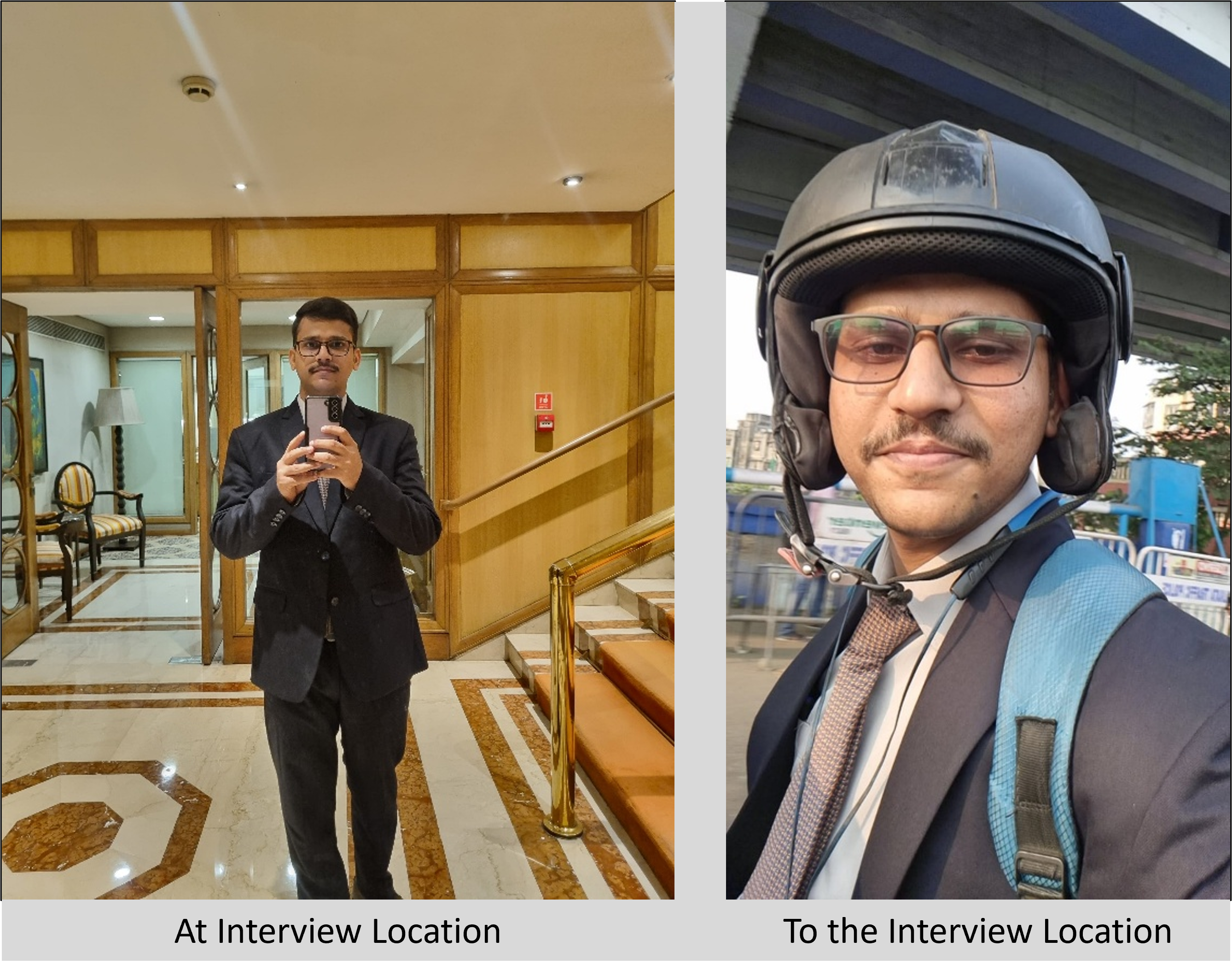
Those 2–3 months of GDPI phase were honestly more tiresome than the entire CAT prep. I travelled to Kolkata every week and did odd shift duties to avoid trouble at work.
When the results rolled in—FMS came first. I was waitlisted at 21 in General, which meant a sure-shot conversion. The result came around 11:30 PM. My parents were asleep, but I couldn’t stop myself—I called them. I had night shift that day, and I spent the whole night feeling like my MBA dream had finally come true.
Then came the Bangalore result—rejected. And finally, the Calcutta result. It was the “Aap Joka aa rahe ho” moment for me.
Finally, the dream of a naive rural boy, who didn’t even know IIM Calcutta existed, came true. I’m going to Joka.
It would be wrong to end this journey without mentioning my parents and friends who helped me through every self-doubt phase, and of course, the God who is the ultimate planner of all.