

Profile: 9/9/8, 2 years of work-ex, CAT score 98%
I’m a full-time software engineer at Samsung in Bangalore—living solo, debugging life and code in equal measure. So naturally, I thought, "Why not spice things up a bit?" Enter: The CAT exam prep :P
This wasn’t just a new challenge; it was my DIY MBA prequel. The journey kicked off the moment CAT opened its registration forms (August 1st week). I enrolled in an online coaching program—CATKing—to get some structure into my chaotic work-life schedule.
Free CAT Mocks 2025: Daily Sectionals!
The Balancing Act: Life, Work, Studies... and Laundry
My weekdays looked something like this:
- 9 to 6: Battling bugs at work
- 8 to 11: Attending CAT classes
- 11 to 12: Self-study (Yes, I’m that guy who writes tomorrow’s plan before sleeping)
In between: Cooking, cleaning, grocery runs, and existential crises
Weekends? A generous 6-7 hours of study. It wasn't a schedule; it was a self-induced bootcamp.
Why Coaching Helped
Perks of joining Coaching:
- Structured timeline (because “plan to study” > “study to plan”)
- Deep chapter-wise insights
- Mocks and analysis
- Consistent classes and doubt-solving
Honestly, it gave me a direction—like GPS for a lost traveler with mild caffeine addiction.
When Life Gave Me Bugs…
Things got interesting (nightmarish) in late September. My team was assigned a high-priority product launch with a blink-and-you-miss-it deadline. Cue late-night debugging marathons that ended well past midnight. Studying took a hit. Wasn't able to focus on my preparations. But hey, isn’t time management what an MBA is all about? So I recalibrated. Missed study hours were compensated after things got back in hand, and I somehow stayed afloat.
Badminton: My Sanity Savior
To avoid becoming a machine (or worse, a cranky machine), I took up a hobby... badminton. Best. Decision. Ever. It wasn’t just fitness; it was therapy. I made friends, cleared my mind, and returned to my books with better focus and fewer dark circles.
Mocks: The Rollercoaster Phase
By October, I shifted gears to full-on mock mode. The scores started decently—85, 90, 94—and I was hopeful. Then came the slump: 70, 66, 59... and -1 in VARC. Yes, you read that right. Negative. One. That was my rock bottom. The "maybe this isn't for me" phase.
But here's the thing: “When you’re going through hell, keep going.” (Winston Churchill)
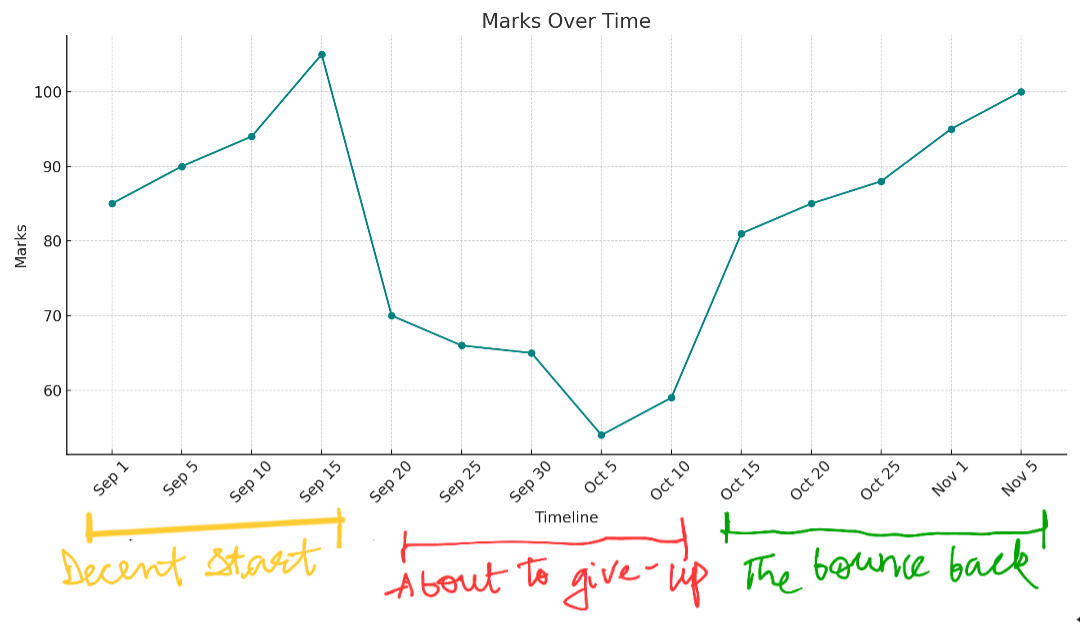
I remembered a distant cousin who had cracked CAT a few years ago. One call later, I was mentally back in the game. He reminded me this is part of the process—mock scores aren't your final result; they’re just noisy feedback. I fixed my weak areas, revamped my strategy, and the scores followed: 81, 85, 88, 95, 100.
D-Day: 24th November, 2024
I walked into the exam hall prepared—but nervous. I avoided panic rabbit holes, gave myself positive affirmations, called my parents, and told myself: “Just do what you’ve done a hundred times in mocks.”
The paper went... decent. Not the best, not terrible. But I walked out with my head high.
Tips for Fellow Warriors:
VARC (Verbal Ability and Reading Comprehension):
1. Read Aeon essays. They’re dense, philosophical, and perfect for taming long RCs (and benefits in PJ and PS).
2. Struggling to concentrate? Scribble somewhere (It’s oddly effective).
3. RC Strategy:
- Skim first and last lines of paras
- Check questions
- Then read the whole thing
4. Parasummary
- Mapping -> Check for the important words in the para that needs to be in PS (options)
- Main idea should be there
- Translate to your language (for me, Hindi)
- Eliminate
- **Extreme words (always/never/must)
- **Out of scope or extends the topic
- **New ideas or change of main idea
5. Parajumbles
- Find combo first (pairs that will definitely go together)
- First part is general idea and hint of the topic
- Second part briefs about topic
- Third part is continuation of Topic or combo (that we identified)
- Conclusion or new topic
LRDI (Logical Reasoning & Data Interpretation):
1. Practice is your only savior. Start easy, scale up.
2. Always do LR before DI. DI is a trap set by demons with Excel sheets :P
QA (Quantitative Aptitude):
1. Complete the syllabus. Don’t leave topics to karma.
2. Learn shortcuts. E.g., Profit 25% = CP:SP :: 4:5. Saves time, saves sanity.
3. Topic-wise revision helps.
Mocks:
- There is no right time to start giving mocks so just start.
- Start with one before even starting prep. Know your level.
- Give full-length and sectional mocks. CAT is not a 2 hour paper, its a set of 3 papers of 40 mins each.
- Analyze mistakes more than you celebrate scores.
The Mind Game
- Meditation helps. Not just for peace—but for clarity.
- Keep your WHY close. Mine? I’ve always wanted to be “the guy who takes the big decisions.” Not just code executor, but a shot-caller.
- Write stuff down. Tiny notes add up. Before exam day, they’re gold.
- Keep phone aside while studying. No mocks on the phone, prepare for the actual setup (desktop screen).
Post-CAT: From Mock Tests to Mock Interviews
The CAT exam was over. Results came in late December—and based on my performance, I knew I’d land a few solid B-school calls. I had applied to SPJIMR, ISB, IIFT, and MDI-G.
Confidence? ✅
Preparation for interviews? ❌
And here's where I slipped: I relaxed too much. After months of juggling mocks, chores, work deadlines..., I let my foot off the gas. I figured, "Let’s chill for a bit." But turns out, a bit became too much. I only began serious interview prep around mid-January.
Interview Prep: Netflix Off, News On!
Cue the pivot: I went from binge-watching Netflix to binge-watching YouTube interviews of top B-school alumni. Every school has a slightly different flavor, and understanding what each values was key. Here’s what I’d strongly recommend to anyone in the same boat:
Interview Preparation Tips
- Improve your spoken English (Fluency builds confidence.)
- Read newspapers daily. It helps in both GDs and interviews.
- Know your projects inside out. What you did, why you did it, the impact, and even what could’ve been done better.
- Know your company well. Basic stuff: origin country, major products, Indian operations, recent news, competitors.
- Smile. A genuine, steady smile makes you seem confident and calm—even if you’re internally screaming.
- Greet the panel. It costs nothing and earns respect.
- Dress formally (complete suit with a tie)
- Don’t give up. I couldn’t answer four consecutive questions in my MDI interview. FOUR. IN A ROW. I thought I’d blown it.
But I kept going, kept smiling, didn’t let the panic show. And guess what?

The Final Verdict :)
I ended up converting MDI Gurgaon—a top B-school—and also some of the baby IIMs. That moment was pure validation. Not just for my CAT prep, but for the whole year of madness.
Key Takeaway
CAT is not easy. But it’s not impossible. The journey will test your patience, sleep schedule, and sometimes your self-worth. But it’ll also show you what you’re capable of. It’s part one of a longer journey. And interviews are not just about how much you know, but how you carry yourself when you don’t.
“Success is not final, failure is not fatal: It is the courage to continue that counts.” - Churchill (again XD)
Signing off,
Amol Jain