

D-DAY STRATEGY
Every journey is unique, and so was mine.CAT was not a by-chance phenomenon that occurred to me. This journey from being a Forensic Science graduate to IIM Calcutta(Jokar) was a rigorously devised blend of hard work coupled with just the right amount of strategy formulation. I would like to share my story with the intent of being able to help some of the non-engineers like me
"Give me six hours to chop down a tree, and I will spend the first four hours sharpening the axe." – Abraham Lincoln.
It took me a while to fathom the significance of personalized strategy formulation based on past year paper analysis, but once I could, my groundwork seemed more lucid. The unpredictability of CAT has always been a looming question over our heads, but I am here to ration my slice of experience with you. The rule of thumb that I followed was building a D Day strategy to dodge the tactical errors during those three hours. From my standpoint, there are specific prerequisites that you need to delve deeper into as a part of the 'sharpening your axe' part of the chore.
My first insight was that there is a clear-cut demarcation between the number of questions you attempt against your accuracy to obtain the desired percentile. Ideally, across the past 4-5 years of CAT, there is a [65:85] ratio, i.e., if you attempt 65 questions with 85-90% accuracy, you can end up with a 99 percentile. There are different permutation and combinations possible for attaining any percentile with an inverse variation between attempt and accuracy.
The next step is to dissect the CAT questions into three broad categorizations, which have two definitions. One of them is linked straight to the actual LOD (Level of Difficulty) of the problem, and the other is more of a relative interpretation.
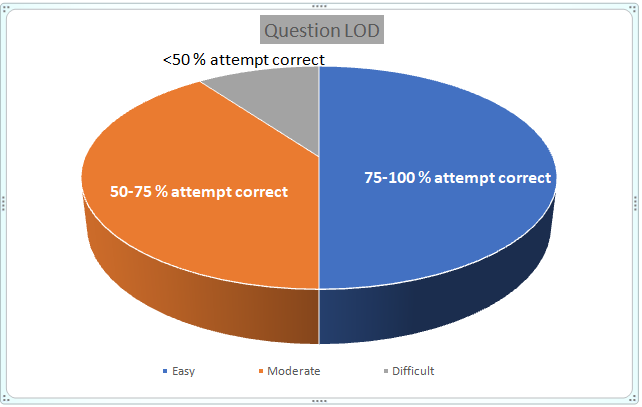
While attempting my CAT 2019 paper, I had a distinct strategy across all sections with these categorizations at the core of my plan of action. Focusing on the 50-60% of the easy category questions places you in a state of exhilaration, relieving you of the psychological pressure and elevating your performance, which is again a pivotal step to your blueprint of the objective.
After all, CAT is an aptitude exam which, if combined with the correct attitude, leads you to the higher altitude.
VARC SECTION
VARC was my set of face cards in the deck. I have observed from my previous year's paper analysis that out of the 50-60% of the easy questions, 80-90% were from the RC section, and out of the 15-20% of the problematic items, 60-80% were from the VA section.
I had decided thereby to focus more on RCs as they are inevitable for a good score. Still, VA is always the game-changer as the medium, and challenging trap questions are the ones that ruin our calculation of accuracy.
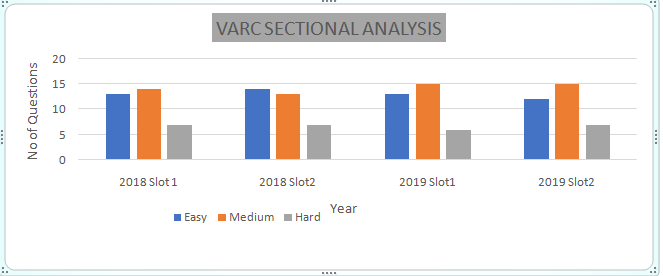
Pro tip: If you are an average performer in VARC, focus on pinpointing the problematic questions and staying away from those chops. Also, start from the VA section as the VARC is the first section. In the initial few minutes of the examination, the concentration is comparatively lesser, and RC requires more attention than the VA.
DILR SECTION
The basic strategy which I followed for my attempt in this section was of precise set selection. I sporadically hunted for those 2 easy sets across the paper, which would fetch me my 'exhilaration wali feel' in this section.
8 correct attempts in 2 sets would fetch me 24 marks, equivalent to 80-85 percentile in the DILR section. My next step was to solve questions across sets and not the sets. 4-5 mix sets have at least 2 easy questions in each one of them combined with medium and difficult level questions. These 8-10 questions were my next target, followed by the medium level questions in the sets attempted for the easy questions.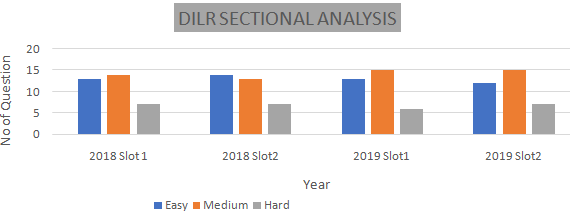
Pro Tip: From the last 2 years, I have seen a trend in DILR that there is an unseen set with a relatively complicated-looking figure, which turns out to be the easiest of the lot.
QA SECTION
Since I am a non-engineer with a non-maths background, I always had this fear intrude into me while attempting this section. I had taken long to formulate my go about in this section. On the D-Day, I started my paper with just one initial thought of a run-through over the entire section in the initial five minutes to spot those easy questions. I started in the middle of the paper, moving on to either side. There is a tendency of decreasing difficulty towards the latter half or an even distribution of easy questions across the two halves. This section is designed in a manner to create a mental blockage for the students in the initial few problems.
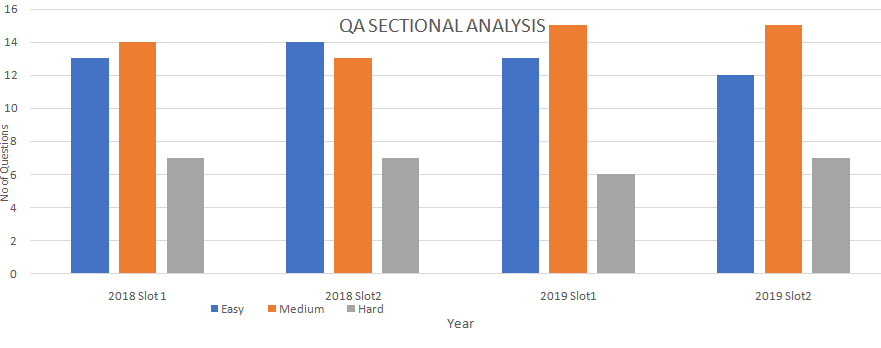
Pro Tip: Compromise with your Id (refer to Sigmund Freud's famous Psychoanalytic theory) for some time and never take a question as a challenge in the exam. Remember that attitude matters.
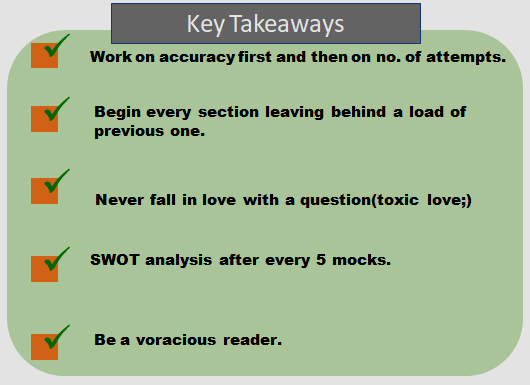
I would like to conclude by saying:
Hustle hard until you succeed!
-PRERNA RAJ