

Traditional resume screening for freshers and campus recruitment in India has long relied on keyword-based ATS filtering systems that scan for specific terms, such as "MBA," "Java," or "internship at XYZ company." However, with the rise of AI-powered shortlisting tools like PotentialAI, Indian employers across Bangalore, Mumbai, Delhi NCR, Chennai, and Hyderabad are witnessing a fundamental shift.
This represents a shift from rigid keyword searches to intelligent automated CV screening for campus hiring, mirroring how experienced human recruiters evaluate talent for campus placements and fresh hiring.
The transformation is particularly impactful in India's hiring landscape, where large organizations across IT hubs routinely receive 5,000–15,000 applications for popular graduate trainee programs. India's hiring market surged by 12% in early 2025, with Bengaluru, Delhi NCR, and Chennai leading hiring growth.
While traditional ATS keyword parsing often overlooks talented freshers from non-mainstream backgrounds, AI-powered shortlisting tools assess complete candidate profiles, evaluating technical skills, leadership potential, cultural fit, and long-term career growth indicators crucial for campus recruitment success.
Why Traditional ATS Systems Fail Indian Campus Recruitment
How does AI resume screening in India differ from traditional methods? Indian companies from Tier-1 cities like Mumbai, Bangalore, and Delhi NCR are increasingly abandoning keyword-based ATS resume filters for campus hiring and fresher recruitment.
Legacy ATS systems consistently fail Indian recruiters targeting graduate talent, especially when applications from engineering colleges, management institutes, and Tier-2/Tier-3 universities use rich but unconventional phrasing.
For example, a qualified B.Tech fresher might write "developed a mobile application using React Native," while the ATS keyword filter looks for "Android development experience." This disconnect leads to qualified campus candidates being automatically rejected.
Keyword-based ATS screening also reinforces existing hiring biases. If traditional systems prioritize terms like "IIT," "IIM," "NIT," or "Big 4 internship," exceptional talent from regional colleges gets excluded by default.
The AI Advantage: Smart Resume Screening for Campus Hiring
What are the advantages of AI resume screening in campus hiring? AI-powered candidate matching tools use machine learning to understand context in fresher resumes. They analyze campus recruitment applications like seasoned HR professionals, interpreting project outcomes, internship experiences, and cultural alignment.
Advanced bulk resume analysis with AI tools like PotentialAI evaluates technical skill signals, leadership indicators, cultural alignment, and growth potential. These resume ranking algorithms systems rank freshers based on role relevance, skills, education, and behavioral cues, creating structured shortlists aligned to campus hiring criteria.
According to NASSCOM's AI Adoption Index 2024, over 87% of Indian enterprises are now in the "Enthusiast" or "Expert" AI adoption stages.
Speed and Scale: AI Transforms High-Volume Campus Recruitment
How fast can AI-powered shortlisting tools process campus applications? Customizable AI agents that analyze resumes like experienced campus recruiters can process applications in under 4-6 hours, compared to weeks for traditional methods.
The UP Police's Chakravyuh initiative successfully handled over 1.5 million applicants, selecting more than 60,000 recruits with zero fraud incidents. Campus recruitment timelines have been reduced by 40-60%, while hiring costs dropped 30–50%.
Bias-free AI shortlisting platforms don't suffer from reviewer fatigue or unconscious bias - each fresher resume gets evaluated uniformly, helping companies discover campus talent faster and more fairly.
Customization for Indian Companies
Modern AI resume screening in India offers powerful customization through adjustable evaluation weightages. Fintech companies in Bangalore may prioritize coding competitions, while FMCG brands in Mumbai weigh communication abilities and regional language skills.
Advanced platforms allow HR teams to upload resumes from target campuses, automatically scoring candidates using job descriptions and past hiring patterns. Location plays a huge role - Bangalore leads salary packages between INR 10-20 lakhs, followed by Mumbai and Hyderabad.
Reducing Bias and Boosting Diversity
How does bias-free AI shortlisting improve campus hiring diversity? AI screening platforms apply consistent evaluation logic regardless of college name, city, gender, or background. Warden AI's 2025 Audit showed 39% fairer treatment toward women candidates and 45% improvement for underrepresented profiles.
Organizations using automated CV screening for campus hiring see a 21% increase in successful hires from Tier-2 and Tier-3 colleges, improving diversity without sacrificing quality.
Real Success Stories and ROI
Campus hiring costs drop by up to 50% when AI-powered shortlisting tools replace manual screening. Time-to-hire reduces by 18–40% for graduate roles, with 30–35% improvement in quality of hire.
75% of Indian recruiters report better hiring outcomes using AI resume screening in India, with improvements in both processing speed and candidate evaluation quality. (source: Economic Times)
The Future of Campus Recruitment
92% of Indian knowledge workers now use AI tools, and 75% of talent leaders won't hire candidates lacking AI fluency. Future campus recruitment will involve multimodal inputs - resumes, videos, assessments, and portfolios - analyzed through AI-powered candidate matching tools.
The global recruitment market is expected to reach USD 2292.24 billion by 2033, with India positioned as a major contributor.
Implementation Framework
What steps should Indian companies take to adopt AI resume screening? For successful AI adoption in campus hiring:
- Assess current hiring volumes and bottlenecks
- Define clear objectives (speed, diversity, accuracy)
- Select customizable AI vendors with proven engines
- Integrate with existing ATS platforms
- Train recruitment teams for AI-human collaboration
- Monitor and fine-tune algorithms continuously
The Bottom Line
The shift to AI resume screening represents a strategic transformation in Indian campus recruitment. Current data shows 59% of Indian enterprises actively deploy AI - the highest globally, with 75% of recruiters investing up to 70% of their budgets in AI hiring tools.
In India's competitive talent market spanning Bangalore's tech hub, Mumbai's financial center, and Delhi NCR's corporate landscape, bias-free AI shortlisting delivers both operational efficiency and hiring equity. Companies implementing automated CV screening for campus hiring today are building inclusive campus recruitment pipelines for sustained competitive advantage.
InsideIIM's Potential AI, an AI-Powered Candidate Fit Engine, exemplifies this transformation, enabling recruiters to process thousands of campus applications with precision while maintaining fairness and discovering hidden talent across diverse educational backgrounds.
How it works: Potential AI's customizable AI agent reads resumes like a human recruiter, adjusting weightages per your hiring philosophy and role requirements.
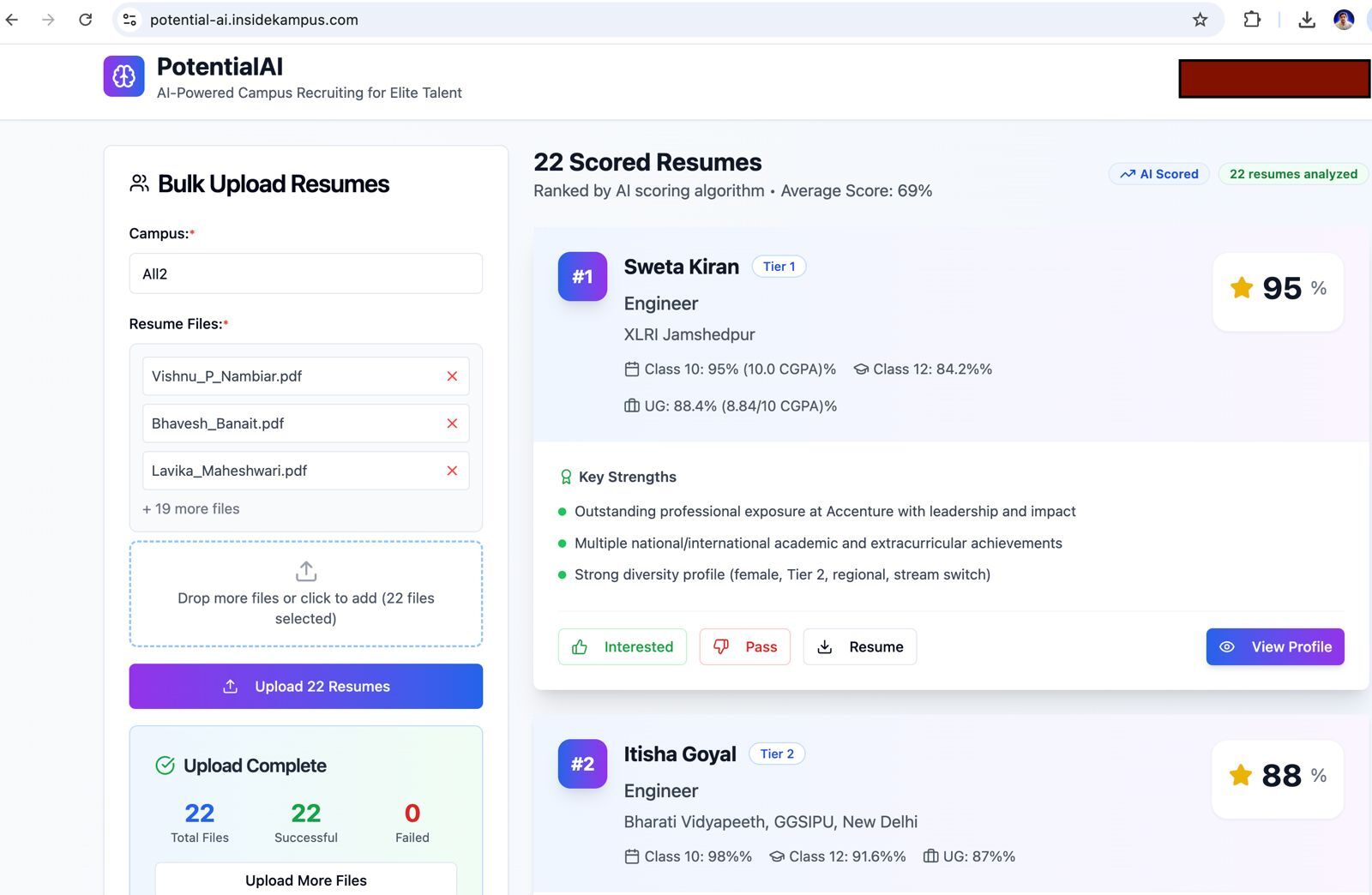
Key outcomes: Faster, consistent filtering of large volumes in hours, not weeks, with full alignment to your specific hiring criteria - from Bangalore's tech skills to Mumbai's corporate communication needs.
Ready to transform your campus hiring? Reach us at hiral.sanghavi@insideiim.com or +91-9769476005