
"Show me how you've driven product innovation using AI."
That single request during an interview is where AI-savvy product managers separate themselves from the competition. In the hyper-competitive Indian tech landscape, an AI-enhanced product management portfolio isn't just a collection of projects — it's your ticket to commanding salaries 30-40% higher than your peers.
Recent industry data reveals a stark reality: Product managers who effectively demonstrate AI integration in their work earn approximately ₹7-10 lakh more annually compared to traditional product managers [ Deloitte Technology Workforce Trends Report, 2024].
Your AI product management portfolio isn't just a collection of projects — it's your most powerful career acceleration tool. While your resume lists responsibilities, your portfolio proves your ability to drive transformative business outcomes through intelligent technology.
Portfolio & AI Depth with Career Impact
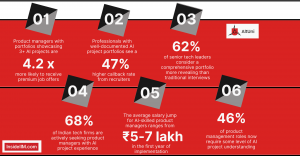
(sources: McKinsey Digital Talent Report, Indeed Tech Recruitment Insights, PwC Digital Skills Assessment, NASSCOM Digital Transformation Report, Gartner Technology Workforce Analysis)
The 5-Step Portfolio Building Framework
Step 1: Problem Identification
- Select projects with clear, measurable business impact
- Focus on solving genuine organizational challenges
- Demonstrate how AI wasn't just a technology experiment but a strategic solution
Step 2: AI Technology Integration
- Clearly articulate which AI/ML technologies you used
- Explain your technical decision-making process
- Show understanding beyond surface-level implementation
Step 3: Quantifiable Outcomes
- Always translate AI impact into business metrics
- Use specific numbers: percentage improvements, cost savings, revenue generation
- Connect technical achievements to strategic business goals
Step 4: Continuous Learning Demonstration
- Show how you adapted and improved AI solutions
- Highlight iterative development processes
- Demonstrate learning from initial implementations
Step 5: Ethical AI Considerations
- Address potential bias in AI systems
- Show awareness of responsible AI development
- Demonstrate a thoughtful, inclusive approach to technology
Exact Phrases to Showcase AI-Powered Product Management Work
For E-commerce Platform AI Integration:
"At [Company Name], I implemented a machine learning-powered recommendation engine that increased user engagement by 42% and drove an additional ₹3.2 crore in quarterly revenue. The AI system dynamically adjusted product recommendations based on real-time user behavior, reducing recommendation-to-purchase conversion time by 67%."
For Fintech Product Optimization:
"Developed an AI-driven risk assessment model for [Fintech Startup] that improved loan approval accuracy by 35% while reducing processing time from 3 days to 4 hours. The predictive algorithm analyzed 47 complex variables, enabling more nuanced credit scoring that expanded our addressable market by 22%."
For SaaS Product Personalization:
"Created an adaptive user experience framework using natural language processing that personalized product interfaces in real-time. This approach increased user retention by 56% and reduced customer support tickets by 43%, directly contributing to a 2.7x improvement in product adoption rates."
The 5-Step Salary Negotiation Framework for Product Managers
1. Quantify AI-Driven Innovation
"My AI integration strategies reduced product development cycles by 40%, enabling us to launch three additional features annually without increasing team headcount."
2. Demonstrate Economic Impact
"The predictive analytics model I implemented identified market opportunities that generated an additional ₹1.8 crore in product revenue within the first two quarters."
3. Highlight Efficiency Gains
"By automating product testing and validation through AI, we reduced quality assurance time by 62% and decreased post-launch bug resolution costs by ₹45 lakhs annually."
4. Use Precise Market Benchmarks
"Based on current market data for AI-proficient product managers in [Your Specialization], compensation packages range from ₹18-25 lakhs, with specialists demonstrating tangible AI implementation skills commanding premium rates."
5. Propose Performance-Linked Compensation
"I'm confident in the value my AI product management expertise will deliver. I propose a compensation structure with a base salary plus performance bonuses tied to measurable innovation and efficiency metrics."
Real-World Impact Statements That Resonate with Hiring Managers
Technology Innovation Metrics:
"Implemented machine learning algorithms that reduced product feature development time by 53%, allowing for more iterative and responsive product cycles."
Cost Optimization Examples:
"Developed an AI-powered resource allocation model that optimized team productivity, resulting in ₹72 lakhs of operational cost savings over 18 months."
Competitive Differentiation:
"Used AI competitive analysis tools to identify three untapped market segments, leading to a new product line that now contributes 18% of the company's total revenue."
Preparing Your AI Product Management Portfolio
Key elements to include:
- Specific AI implementation projects
- Quantifiable business outcomes
- Technology stack and tools used
- Cross-functional collaboration examples
- Metrics demonstrating direct business impact
Industry Validation
The Indian tech ecosystem is rapidly transforming. Product managers who can demonstrate AI integration skills are no longer just preferred — they're becoming essential. By building a portfolio that showcases your ability to leverage AI for product innovation, you're positioning yourself in the top 10% of product management talent.
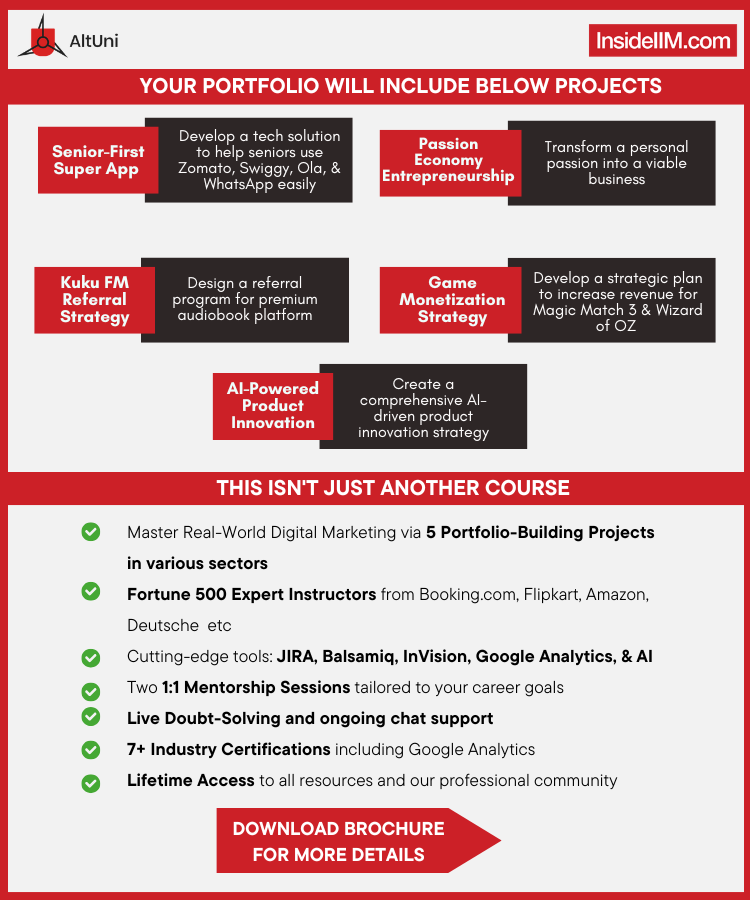
Our Certificate Program in Product Management with Gen AI is designed to equip you with the exact skills, projects, and portfolio-building strategies that command premium compensation in today's competitive market.
The question isn't whether you can afford to invest in building an AI product management portfolio. The question is: can you afford to be left behind in the AI-driven product innovation wave?